Mission Support / 2026
Mission systems. Inspectable work.
Mission support.Made tangible.
Three interactive applications for the work behind readiness.
A maintenance blocker. An inventory discrepancy. A record that cannot be released. Explore how clear interfaces turn each into a visible decision, a defined next step and an inspectable record.
Three ways to inspect the work
Equipment readiness
See the blocker. Record the decision.
From an inspection gate to a reviewer release.
Evidence capture
Activity record
Supply accountability
Every item. Every handoff.
From a count difference to a reviewed reconciliation.
Review gate
Exportable ledger
Data exchange sandbox
Make every validation decision inspectable.
From a field-level finding to a permitted simulated release.
Policy explanation
Decision history
What this work can show
Workflow design, responsive application interfaces, constrained inputs, explicit state transitions, actionable validation and downloadable records. Each scenario can be reset and explored again.
How to evaluate it
Start with the seeded scenario. Try an invalid action. Complete the permitted path. Compare the screen with the export. Reset. The following pages give a concrete walkthrough for each application.
01 · Equipment readiness
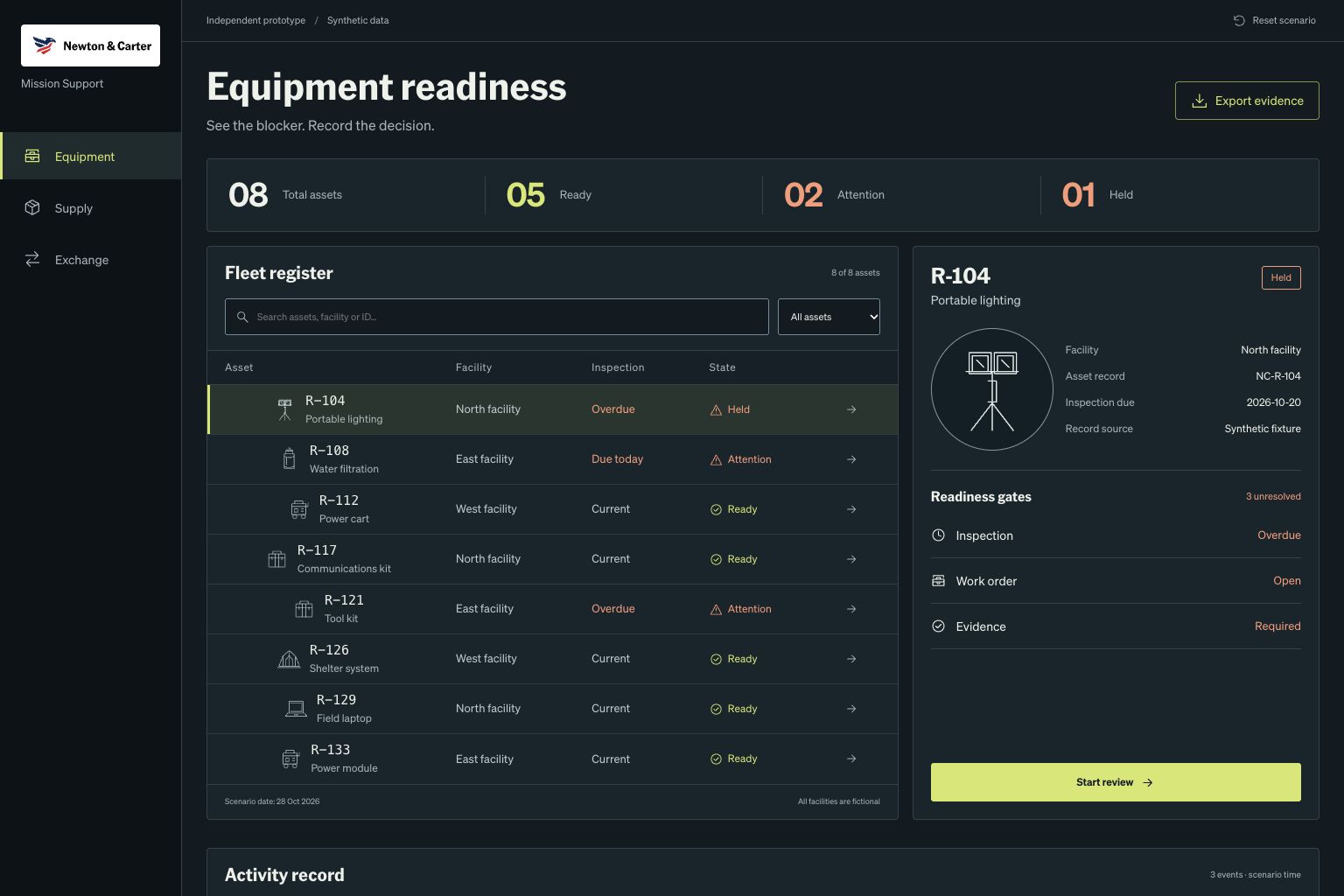
Equipment readiness
See the blocker. Record the decision.
Make the path from maintenance evidence to release visible.
The design question
Can a coordinator explain an equipment status and identify the next permitted action without switching between disconnected records?
- Selectable assets with search and filters.
- Generic inspection evidence and work-order closure.
- Reviewer release, activity history and JSON export.
Walk through the decision
- Reset. Inspect R-104 and name its visible blockers.
- Attempt release early. Inspect the reason it cannot proceed.
- Record inspection evidence, close the blocking work order, then record the reviewer release.
- Compare the asset, counts and activity with the JSON export. Reset the scenario.
| Check | Acceptance criterion |
|---|---|
| Gated release | Incomplete required work cannot produce a released state; blank required evidence is rejected. |
| Coherent records | Summary counts, selected detail and exported state agree; each accepted action is visible in activity. |
| Repeatable scenario | Reset restores the initial records, gates and counts without retaining the previous run's actions. |
Scope boundary. Ordinary facility assets and generic procedures. No diagnostics, predictive maintenance, medical-device instructions, live telemetry or real release authority. Reviewer actions are simulated, not authenticated maintenance records.
Official context.Army reporting describes maintenance accuracy and equipment reliability as important to readiness. This concept applies a general workflow pattern; it does not implement an Army program. Army maintenance report · February 9, 2026 ↗
02 · Supply accountability
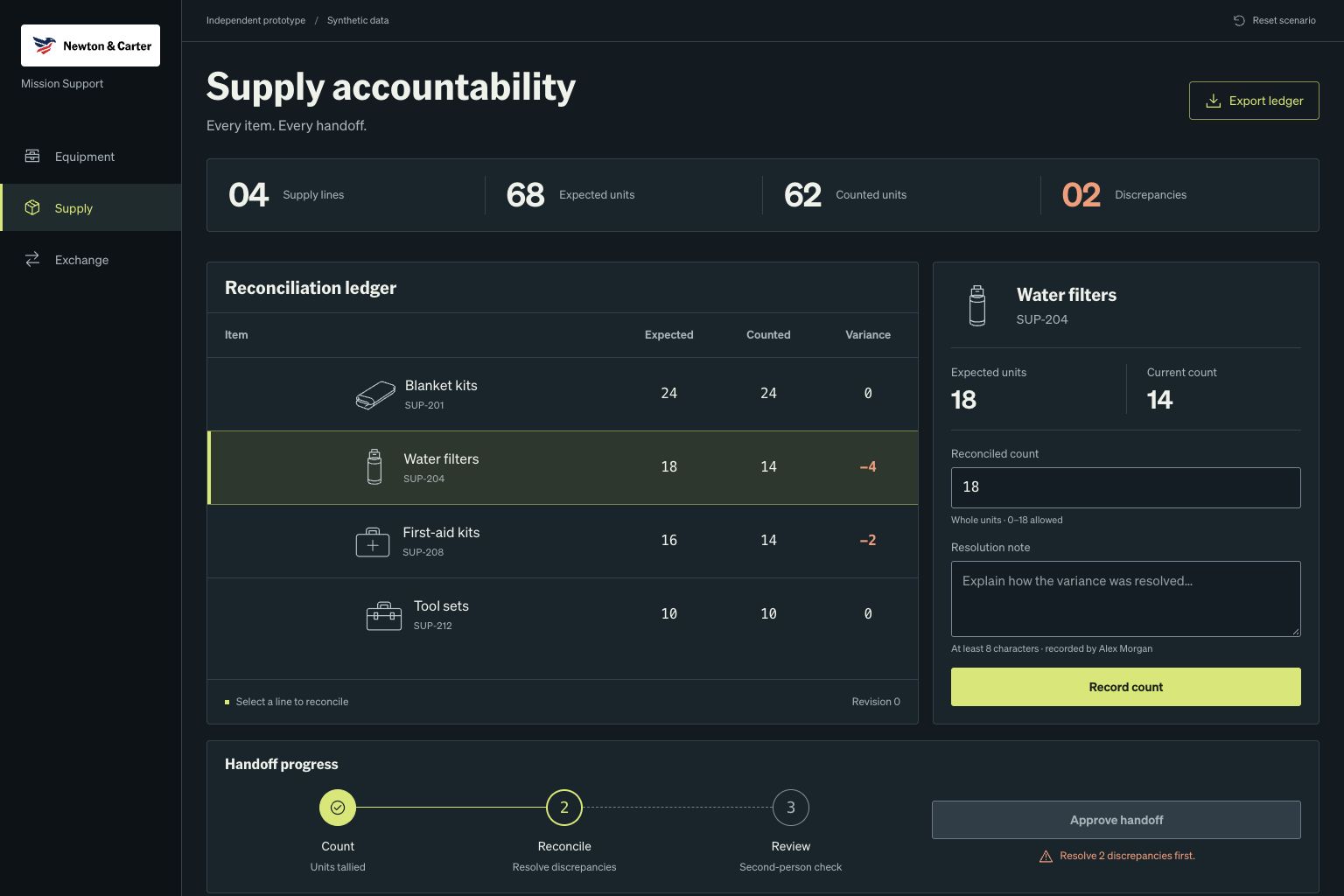
Supply accountability
Every item. Every handoff.
Keep a discrepancy, its explanation and its review connected.
The design question
Can a coordinator reconcile a count without losing the reason for the change or bypassing the review before handoff?
- Expected and counted quantities kept visible.
- Bounded input with a required reconciliation reason.
- Simulated second-person review and ledger export.
Walk through the decision
- Reset. Find the two discrepancies and inspect the water-filter line.
- Try an invalid or over-expected count, then a blank reason. Inspect the validation.
- Resolve both discrepancies. Attempt handoff before review, then complete review and handoff.
- Compare the ledger and decision sequence with the JSON export. Reset.
| Check | Acceptance criterion |
|---|---|
| Valid quantities | Only whole counts from zero through the line's expected quantity are accepted in this scenario. |
| Reviewed handoff | Resolve all discrepancies with reasons, then review before handoff. Changed counts invalidate the review. |
| Ledger integrity | Line quantities sum to the displayed and exported totals; reset restores 68 expected and 62 counted. |
Scope boundary. No physical scans, live stock system, transport routing or actual custody transfer. A simulated reviewer is not identity verification or segregation-of-duties enforcement. Over-counts are intentionally blocked; a production overage policy requires agreement.
Official context.The Army describes digital inventory and inspection workflows in its supply-chain application reporting. This independent concept does not connect to ParaLine, CheckMate, GCSS-Army or LMP. Army application preview · March 31, 2026 ↗
03 · Data exchange sandbox
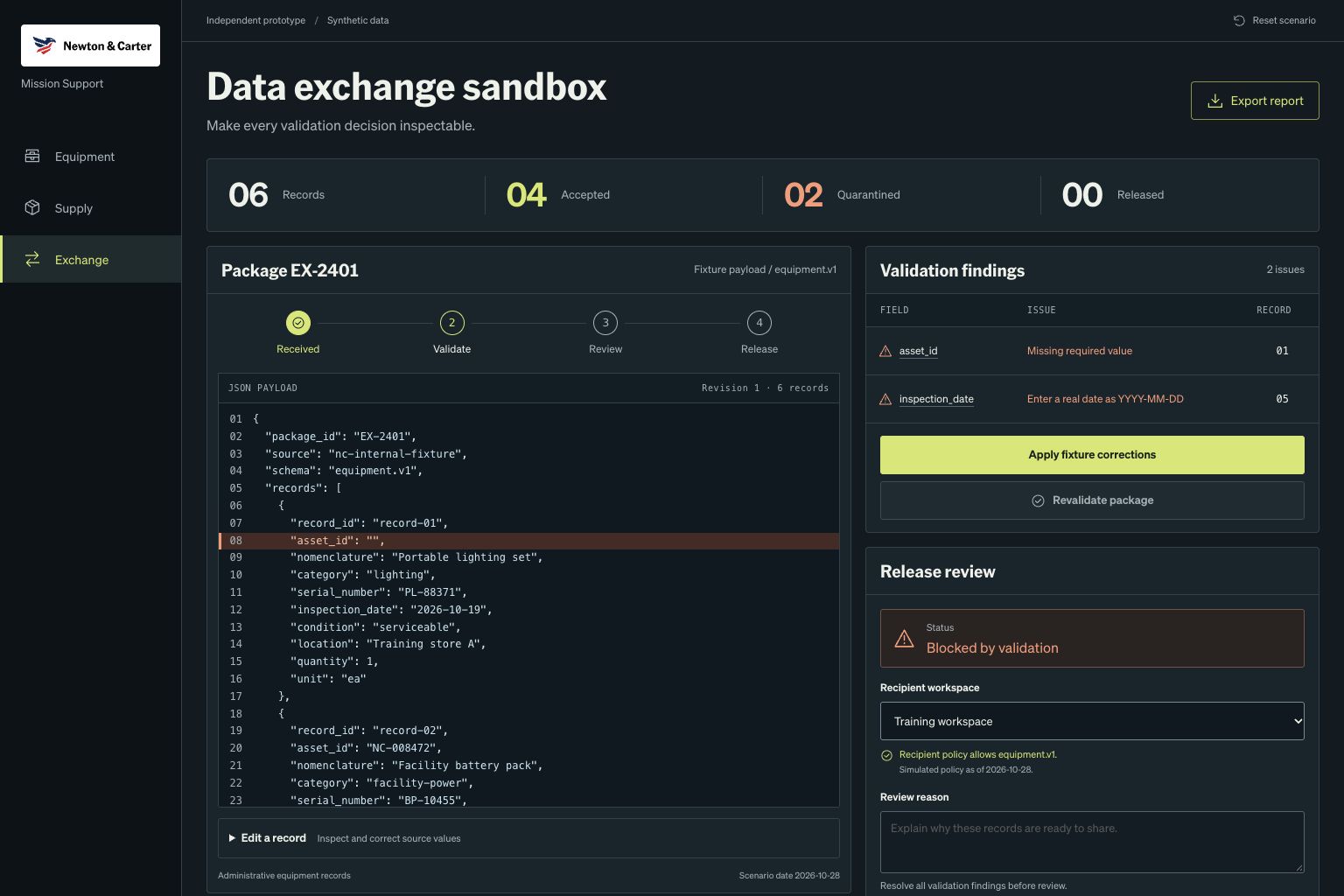
Data exchange sandbox
Make every validation decision inspectable.
Expose the finding, the correction and the release decision.
The design question
Can a reviewer see precisely why a record failed and what rule permits or blocks its release, without treating validation as a black box?
- Payload inspection and field-specific findings.
- Fixture correction, revalidation and explicit review.
- Simulated recipient policy and decision-event export.
Walk through the decision
- Reset. Inspect a quarantined record and its exact field-level finding.
- Attempt release before eligibility. Correct both fixture errors and revalidate the package.
- Try a denied recipient, then review and release to a permitted simulated recipient.
- Compare records, findings and events with the export. Reset to the original scenario.
| Check | Acceptance criterion |
|---|---|
| Useful validation | Invalid records identify the affected field and a correction; accepted does not automatically mean released. |
| Explicit gates | A package with findings, stale validation or no applicable review cannot release; a denied recipient remains blocked. |
| Inspectable state | The export matches records, findings and events; reset restores four accepted, two quarantined, zero released. |
Scope boundary. Local policy and reviewer simulation only. No authentication, access enforcement, secure transfer, clinical exchange or HL7/FHIR implementation is demonstrated. The export is not immutable audit evidence. No security or compliance certification is claimed.
Procurement reference.DHA opportunity notice on SAM.gov ↗ is supplied context only. Its requirements are not assessed here. No clinical integration, compliance, endorsement or award is implied.